Uptime monitoring answers one deceptively important question: is my site actually up right now? A monitoring tool checks your website, server or API on a schedule and alerts you the instant it stops responding — before your customers notice. Below are the best uptime monitoring tools of 2026, compared by price, check frequency, features and free-plan limits.
Quick comparison
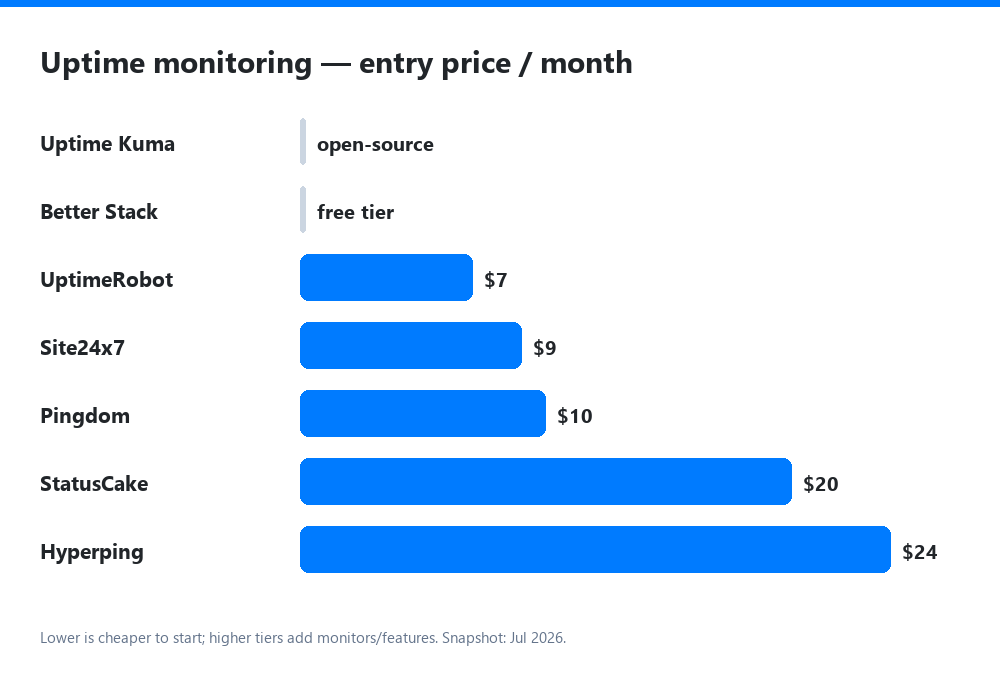
| Tool | Free plan | Paid from | Fastest check | Best for |
|---|---|---|---|---|
| UptimeRobot | ✅ 50 monitors (personal) | $7/mo | 60s | Value & getting started |
| Better Stack | ✅ (with status page) | usage-based | 30s | All-in-one (uptime + on-call) |
| Pingdom | ❌ trial | $10/mo | 1 min | Performance & real-user data |
| Site24x7 | Trial | ~$9/mo | 1 min | All-in-one infrastructure + uptime |
| StatusCake | ✅ | ~$20/mo | 30s | Uptime + status pages combo |
| Hyperping | Trial | $24/mo | 20s | Flat-rate monitoring + status + on-call |
| Uptime Kuma | ✅ (self-host) | Free (OSS) | flexible | Zero-cost, self-hosted |
Pricing is a July 2026 snapshot and changes often — confirm on each vendor’s plan page before buying.
The best uptime monitoring tools
1. UptimeRobot — best value and best free tier
The most popular entry point to uptime monitoring. The free plan gives you 50 monitors at 5-minute checks (personal, non-commercial use only since late 2024). Paid plans start at $7/mo (Solo) with 60-second checks, scaling to Team ($38/mo, 100 monitors) and Enterprise. Simple to set up and hard to beat on price.
- Best for: startups, developers and anyone starting out.
- Compare it head-to-head: UptimeRobot vs Pingdom.
2. Better Stack — best all-in-one
Better Stack combines uptime monitoring, on-call scheduling, status pages and incident management in one modern platform, with a genuinely useful free tier (including a hosted status page). Pricing is usage-based as you add seats and monitors.
- Best for: teams that want monitoring and incident response in one tool.
3. Pingdom — best for performance depth
A SolarWinds product focused on more than uptime: real user monitoring (RUM), page-speed and transaction checks. There’s no free plan and it’s pricier (synthetic from ~$10/mo, RUM sold separately), but you get performance analytics UptimeRobot doesn’t offer.
- Best for: teams that need real-user and page-speed data, not just up/down alerts.
4. Site24x7 — best broad infrastructure coverage
Part of the Zoho/ManageEngine family, Site24x7 bundles uptime with server, network and application monitoring, so it can grow into a full infrastructure suite. Affordable entry pricing.
- Best for: teams wanting uptime plus deeper infrastructure monitoring from one vendor.
5. StatusCake — solid uptime + status pages
A well-established service pairing reliable uptime checks with built-in status pages and a usable free tier. Good mid-market value.
- Best for: teams wanting monitoring and a status page from one affordable vendor.
6. Hyperping — best predictable flat rate
Hyperping bundles monitoring, status pages and on-call at flat rates (from $24/mo) with no usage surprises and fast 20-second checks on higher tiers.
- Best for: teams that want one predictable bill for monitoring + status + on-call.
7. Uptime Kuma — best free & open-source
A self-hosted, MIT-licensed favorite. Completely free if you run it yourself, with a clean UI and a built-in status page — you just provide the hosting.
- Best for: homelabs and cost-sensitive teams comfortable self-hosting.
How to choose an uptime monitoring tool
- Just getting started / cost-sensitive? UptimeRobot (or Uptime Kuma if you’ll self-host).
- Want monitoring plus incident response and a status page? Better Stack or Hyperping.
- Need real-user and page-speed data? Pingdom.
- Want uptime as part of broader infrastructure monitoring? Site24x7.
Two things to prioritize when choosing: check frequency (faster intervals catch outages sooner) and alerting channels (email, SMS, Slack, webhook, on-call) so the right person hears about downtime immediately. If you also need to communicate outages to customers, pair your monitor with one of our best status page tools.
Go deeper
- Best Server Monitoring Tools — the inside-out complement to external uptime checks.
- Best Server Monitoring Tools for Linux — Linux-specific picks (Netdata, Zabbix, Prometheus).
- Best Free Uptime Monitoring Tools — every genuinely free option with catches documented.
- Best Synthetic Monitoring Tools — scripted user-journey checks in real browsers.
- What Is Uptime Monitoring? — the concept explained, with the downtime math for every “nine”.
- How to Monitor Website Uptime — step-by-step setup guide.
- Uptime vs Availability vs Reliability — SLAs, SLOs, SLIs and error budgets.
- Website Monitoring for E-commerce — checkout-journey monitoring and peak-season prep.
- Pingdom vs StatusCake — head-to-head comparison.
- UptimeRobot vs Pingdom — head-to-head comparison.